


Stage Size, Entry Gate & Mandap Area Guide for Wedding Venues in Delhi NCR
Planning a wedding in Delhi NCR is more like directing a big-budget movie than putting on an event. The scale is always “grand,” whether it’s the huge farmhouses in Chattarpur, the sleek banquet halls in Gurgaon, or the old-fashioned feel of North Delhi.
As a wedding content strategist with extensive experience, I’ve observed couples who fall in love with a decor mood board, only to discover on the big day that their stage feels as small as a postage stamp or that their mandap is so cramped that the Pandit Ji is nearly sitting on the groom’s lap. You must master the use of the entry gate, the stage, and the mandap, the three most crucial components of wedding spatial design, to achieve a flawless venue layout.
The Entry Gate: Setting the Tone
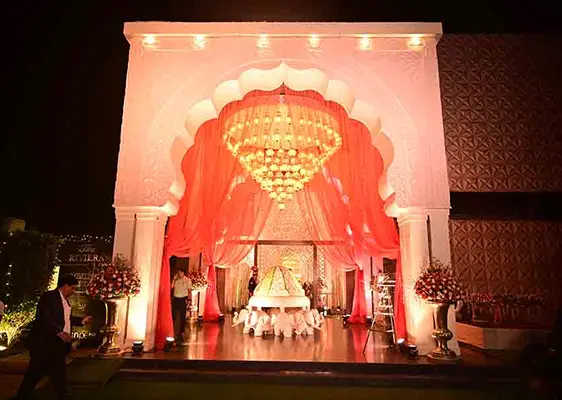
The “First Impression Officer” is the person at the entry gate. In the Delhi NCR circuit, where Baraats can have anything from old cars to brass bands, the gate needs to be both wide and inviting.
- Standard Size: A gate width of 12 to 16 feet is perfect for most high-end places. This ensures unobstructed passage for the couple’s car or the Baraat procession.
- The “Grand” Factor: If you want a big floral arch or a Rajwada-style fiber gate, make sure it’s 14 to 18 feet tall. This makes sure it stands out even from the main road.
- Tip: Always think about the “Passage Area.” Guests love the 20-foot-long floral tunnel (passage) that goes from the gate to the lawn. It makes for a wonderful transition in their Instagram reels.
The Wedding Stage: Architectural Integrity
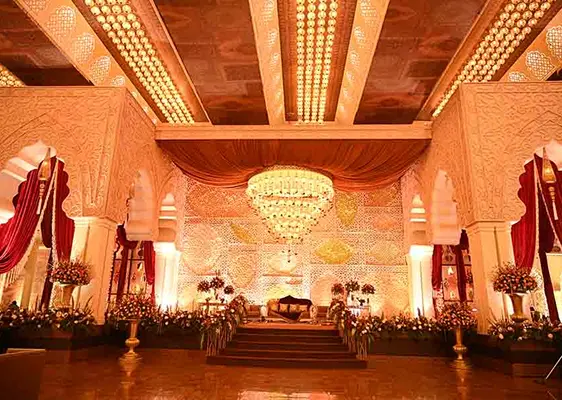
In 2026, the trend has shifted from “over-decorated” to “architectural sophistication.” We are seeing a move toward monochrome palettes, curved sculptural panels, and fluted textures that make the couple stand out without the clutter. Your stage isn’t just a platform; it’s a cinematic frame.
- Intimate “Boho” Setup: Perfect for up to 250 guests. Keep the elevation low (around 2 feet) to maintain a conversational, warm connection. Focus on organic textures like pampas grass and matte ivory finishes.
- Premium “Editorial” Setup: The standard for most NCR banquets (300-600 guests). The ideal height is three feet, which guarantees your visibility above the crowd and provides your photographer with clean, professional sightlines.
- Grand “Stadium” Setup: For large farmhouses with 800+ guests, go big with a 4- to 5-foot elevation. These stages function as theatrical sets, using massive sculptural backdrops and integrated LED walls to ensure you remain the center of attention even in a vast space.
The Mandap Area: The Sacred Circle
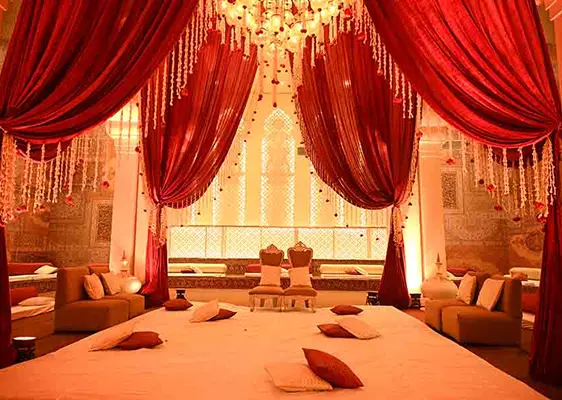
The stage is for the “show,” and the mandap is for the “soul.” This location is where the real ceremonies take place. The mandap shouldn’t be too big, though, because it will lose its sacred, cozy feel.
- The 10×10 Rule: A normal mandap is 10 feet by 10 feet or 12 feet by 12 feet. This space is a good size for the couple, the priest, and the parents present.
- The Elevation: We strongly suggest a 6-inch to 1-foot wooden platform (pata) even if your ceremony is on the ground. It marks the holy space and keeps your heavy wedding clothes off the ground.
- The “Phera” Clearance: Make sure there is at least 3 to 4 feet of open space around the Havan. The Kund is located in the middle of the mandap. You don’t want your 5 kg bridal dupatta to catch fire or trip you up during the Seven Vows.
Designing for the “NCR Flow”
To truly surpass the “Delhi-Proof” standard, your layout must consider the distinct rhythm of a North Indian wedding.
- The Baraat Buffer Zone: There should be at least 100 feet of open space between the entrance gate and the first guest seating area. This is a “holding zone” where the Baraat can finish their hour-long performance without getting in the way of other VIPs coming in.
- Climate-Controlled Choreography: In 2026, comfort is paramount. Make sure that your stage and mandap are close to high-capacity mist fans or industrial heaters, but hide them behind flower panels so they don’t ruin the pictures.
- Vastu & Tech Integration: Traditionally, the Mandap should be in the northeast, facing east. But for 2026, make sure your “Tech Lead” has mapped the power load. Heavy mandap lighting and huge LED stages can blow a normal venue circuit.
Conclusion
Ultimate success in a Delhi NCR wedding hinges on balancing grandeur with structural precision. By mastering entry logistics, ensuring stage visibility, and maintaining the sacredness of the mandap, you can transform a sprawling venue into a seamless, cinematic experience that is both breathtakingly beautiful and perfectly functional.
Leave a Reply